Settings
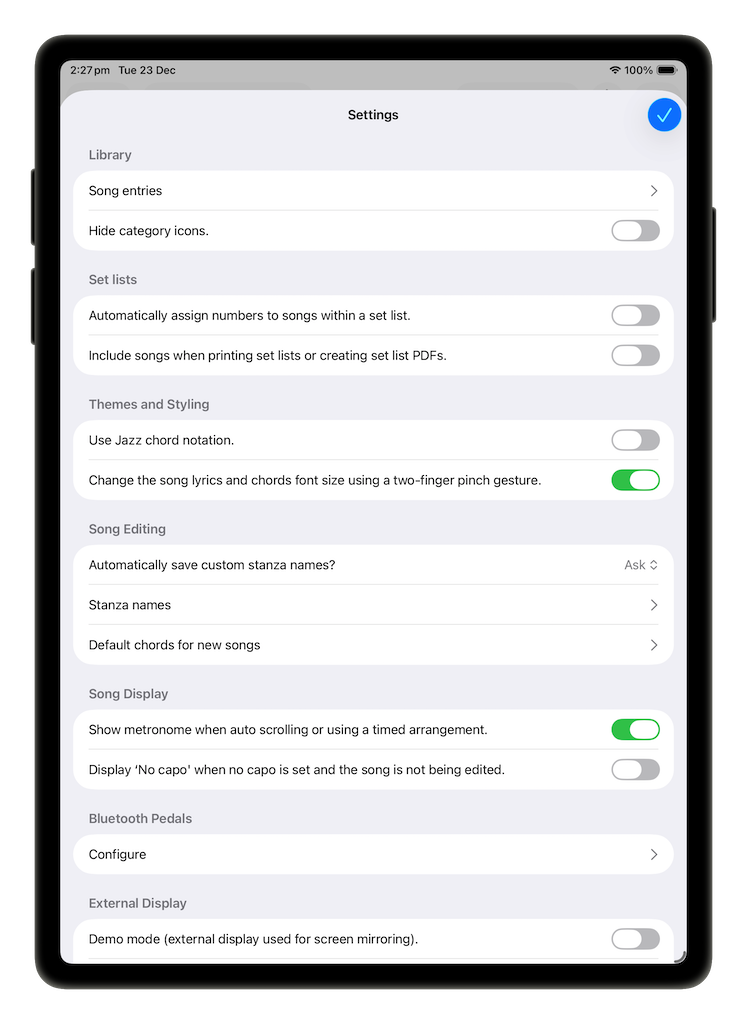
Library
Song entries.
You can choose to display the following information in the song lists:
- Artist name
- Song key
- Capo
- Song duration
- Tempo
By default, artist name, song key, and song duration are displayed. You can toggle the display of any of these in song lists (all songs, set lists, etc) by tapping on the toggle switch next to the information you want to display or hide.
Hide category icons.
When toggled off, this will show the images displayed in front of the different categories in the left pane in the Library view, such as the symbols in front of All songs, Artists, Favorites, Flagged, Tags and Setlists. When toggled on, this will hide the symbols.
By default, this is toggled off.
Setlists
Automatically assign numbers to songs within a setlist.
When this setting is on, a number will be displayed in front of each song in a setlist to denote its position within the setlist. This setting is useful if you want to quickly see what position a song is within the setlist.
Note: The numbers do not reset between sets within a setlist. So if you have a setlist with two sets, each containing two songs, the songs will be numbered 1-4, and not 1-2 twice!
Note: This setting does not affect anything when you export a setlist as a PDF or print it.
By default, this is toggled off.
Include songs when printing setlists or creating setlist PDFs.
When this setting is off, PDFs generated from setlists will only include the song list. The resulting PDF will be a title page showing the songs in the setlist with their key, separated by sets.
When this setting is on, generated PDFs will include all songs in the setlist, with each song starting on a new page. Each song will have a heading displaying the song title, artist(s) and key. The body of the song will include the stanza names, chords and notes.
By default, this is toggled off.
Themes and styling
Use jazz chord notation.
When viewing songs in the song library, SongSheet Pro will change the appearance of some chords depending on this setting. When this setting is on, minor chords will appear with a “-“, major chords will appear with a “∆”, augmented chords will appear with a “+”, and diminished chords will appear with an “o”. So for example:
- Am → A-
- Amaj → A∆
- Aaug → A+
- Adim → Ao
This will affect the appearance of chords in the song view and in the chord palette, but not in the chord editor.
By default, this is toggled off.
Change the song lyrics and chords font size using a two-finger pinch gesture.
When this is on, you can use a two-finger pinch gesture to change the font size of the lyrics and chords. When this is off, SongSheet Pro disables the gesture to prevent accidentally changing the size of the text.
This setting edits the current theme and is applied for all songs when using the theme.
By default, this is toggled on.
Song editing
Automatically save custom stanza names?
When modifying the stanza name of a song, you can choose from a list of pre-set names, or you can create a custom name of your own. This setting controls the behavior of the app when creating a new stanza name.
The three options are Always, Never, and Ask. When set to Always, all newly created stanza names will be added to the default list and will be accessible next time you want to change a stanza name. When set to Never, new stanza names will not be saved, and will have to be re-entered if you want to use them again. Finally, Ask will provide a pop-up that allows you to Cancel or Save the stanza name as a default every time you create a new stanza name.
By default, this is set to Ask.
Stanza names
Tapping on this will open up a list of all saved stanza names in SongSheet Pro. From here you are able to add new stanza names by tapping on the plus symbol at the top of the list, or you can delete stanza names by swiping on the name to the left and tapping Delete, or by tapping on Edit and then the red circle to bring up the Delete option. Tap Done once you are finished removing stanza names.
Note: Deleting a stanza name will not delete any instances of the name within your library.
The default stanza names are Bridge, Chorus, Intro, Outro, Pre-chorus, Refrain, and Verse.
Default chords for new songs
Whenever you create a new song, SongSheet Pro will populate the chord palette with a set of default chords. Tap on this setting to view these chords. On this screen, you will be able to remove any default chords that you wish by either swiping on the entry and tapping on Delete or tapping on Edit then on the red button.
To add default chords, simply tap on the plus button to bring up a diologue box where you can type in any chord. If SongSheet Pro is able to recognise the chord, it will format it as such, but if not, it will leave the text as is. The next time you create a song, the new default chord will appear in the chord palette for ease of use.
Song display
Show metronome when auto scrolling or using a timed arrangement.
When this setting is on and you are using SongSheet Pro’s autoscroll feature or its timed arrangement feature, SongSheet Pro will display a small pulsing dot in the top right of the screen. This metronome will pulse at the speed set by the song’s tempo. The color will be the same as the chords and can be set in SongSheet Pro’s theme editor.
Note: If the song does not have a tempo set, this metronome will not be displayed.
By default, this is toggled on.
Bluetooth pedals
Configure
See the article on Bluetooth pedals for more details on how they work.
SongSheet Pro offers six commands that have configurable keyboard inputs. In the Configure menu you will be able to see each of these commands. When you tap on one of the commands, SongSheet Pro will start ‘listening’ for a new input. Press a key on a connected external keyboard or Bluetooth pedal to link that key up with the command.
If you want to clear the trigger for a specific command, tap on the command then on the trash bin icon in the top right of the window. To save your changes so that they take effect, tap on Save Changes in the bottom left of the window. To reset the command triggers to their defaults, tap on Load Defaults in the bottom left of the window.
By default, the configuration is set to:
- Previous song: ←
- Next song: →
- Play/Pause: space
- Advance 2s: ⏎/return
- Previous stanza: ↑
- Next stanza: ↓
External display
Demo mode (external display used for screen mirroring).
When this setting is off, a connected external display will show the song lyrics using the presentation theme. Use the external display preview to see what the external display will show when this setting is off.
When this setting is on, the external display will mirror exactly what is on the iPad. This is particularly useful when you are teaching a group of people how to use SongSheet Pro.
By default, this is toggled off.
Centre text on external display.
SongSheet Pro will display the stanza on an external display as a left-aligned block of text. This setting adjusts the location on the external screen that you would see the block of text.
When this setting is on, the block of text is centered both horizontally and vertically. When this setting is off, the block of text is centered horizontally, but will be located at the top of the screen vertically.
By default, this is toggled on.